
Can you delete a bad Google review?
No. Not Cloutly, not an agency, not a "reputation repair" service. Nobody can delete a review from Google on your behalf.
A review comes down in exactly two situations: the person who wrote it deletes it, or Google removes it because it breaks one of their policies. That is the whole list.
Removal services do exist, and they are not all the same business. At the legitimate end are law firms pursuing genuinely defamatory reviews, which is a real mechanism and is covered below. At the other end are outfits charging you for a report you could file yourself in two minutes, or — far worse — selling fake reviews to bury the real one.
The useful news is that "you cannot delete it" is not the same as "you can do nothing". There are three real options, in order of how often they apply: report it if it breaks the rules, reply to it, and outnumber it.
What Google will actually remove
Google removes reviews that violate its content policies. It does not remove reviews for being negative, unfair, or wrong. Being furious about a review is not grounds, and neither is disagreeing with it.
These are the grounds that do count, from Google's prohibited and restricted content policy:
- Fake or misleading — reviews paid for in money or in kind, multiple accounts run by one person, or reviews from people with no genuine experience of your business
- Conflict of interest — reviews from current or former staff, family, or competitors
- Off-topic — political or social commentary, or personal rants unrelated to actually visiting you
- Harassment and offensive content — threats, doxxing, deliberately provocative language, and unsubstantiated allegations of unethical behaviour
- Personal information — someone's name, photo, financial or medical details posted without consent
- Advertising and solicitation — promotional content or contact details left to tout for business
- Repetitive content — the same review posted again from one account or several
- Restricted content — promotion of illegal products or services
Read that list against your review honestly before you report. A one-star with no comment from someone who genuinely came in and left unhappy is a legitimate review, however much it stings. A one-star from a competitor, or one that names an employee and accuses them of something, is a different matter entirely.
How to report a review on Google
Two routes. Both are free, and neither requires anybody's help.
From your Business Profile
- Open your Business Profile and select Read reviews
- Click the Report icon next to the review
- Choose the violation reason
- Select Send report
From the Reviews Management Tool
This is the better route, because it also shows you what happened next.
- Open Google's Reviews Management Tool and confirm the email your profile sits under
- Select your business, then Report a new review for removal
- Click Report next to the review, pick the category, and submit
Google says evaluation typically takes several days. In the tool, each report shows one of three states: Decision pending, Report reviewed — no policy violation, or Escalated — check your email for updates.
If a report is rejected and you believe it was wrong, you can appeal. Select up to 10 eligible reviews in the tool and submit the appeal with extra context — this is your chance to explain what the reviewer left out, so use it properly rather than restating that the review is unfair.
Set your expectations sensibly. Google blocked or removed over 292 million policy-violating reviews across 2025, so the enforcement is real — but it is aimed at policy breaches, not at reviews you would rather not have.
What about lawyers and cease-and-desist letters?
This is how the serious removal firms actually work, and it is worth understanding rather than dismissing. There are three legal routes, and none of them is the free reporting flow above.
- A letter to the reviewer. A solicitor writes to the author asking them to remove a statement said to be defamatory. If they take it down themselves, that is one of the only two ways a review ever disappears — the author deleted it.
- A defamation complaint to Google. Separate from policy reporting, Google runs a legal removal process that accepts defamation claims. Google weighs the public interest in the information against your rights under the applicable law, and expects a claim that is specific and well supported — you have to show what is untrue, not merely unwelcome.
- A court order. Google will act on a valid order signed by a judge that identifies specific URLs and finds the content unlawful.
So a firm with lawyers does have tools you do not. What it cannot do is make a fair negative review vanish, because none of those routes reaches a customer accurately describing a bad experience.
Whether a claim is even open to you varies a great deal by country and by how your business is structured — in some places a company above a certain size cannot bring a defamation claim at all, and several require a formal notice before proceedings can begin. Two practical cautions regardless of where you are: legal threats over reviews often draw far more attention to the review than it was getting on its own, and a letter that reads as intimidation can turn one unhappy customer into a story about how your business handles criticism.
If a review is genuinely defamatory — untrue as a statement of fact, rather than simply unfair — or if it names an employee and accuses them of something serious, that is a conversation with a lawyer where you trade, not with a removal service. Nothing here is legal advice.
What happens if you try to game it instead
This is the part the "review removal" services never mention.
When Google detects fake engagement on a profile, it does not just delete the fake reviews. Per Google's own account of how it protects businesses on Maps, it removes the fake content, pauses new reviews on the profile, alerts the owner, and displays a notification banner telling consumers why contributions are paused.
Sit with that for a moment. You bought reviews to look more trustworthy, and the outcome is a public notice on your listing plus an inability to collect the genuine reviews you were going to earn anyway. One honest one-star is survivable. That is not.
The same logic rules out filtering your customers so only happy ones get asked — review gating, which is against Google's policies. We cover why Cloutly deliberately does not do it in Can Cloutly protect me against negative reviews?
What actually works: outnumber it
A bad review does two kinds of damage — it moves your average, and it sits there being read. Volume fixes both, and this is the part that is genuinely in your control.
Here is what a single one-star costs you, depending on how many reviews you already have:
| Reviews before | Average after one 1★ | What it cost you |
|---|---|---|
| 10 | 4.64 | −0.36 |
| 25 | 4.85 | −0.15 |
| 50 | 4.92 | −0.08 |
| 100 | 4.96 | −0.04 |
| 250 | 4.98 | −0.02 |
Illustrative — it assumes you were on a clean 5.0, which almost nobody is. But the shape is the point: the same review that knocks a third of a star off a small profile barely registers on a busy one.
The second effect matters just as much. Reviews are read newest-first, so a steady flow of recent ones pushes an old complaint down the page until most people never scroll far enough to find it. A bad review from March is only a problem if it is still the first thing you see in July.
This is the actual job Cloutly does. Rather than asking for reviews when someone remembers to, a review campaign asks every customer, automatically, by SMS and email, so the flow does not depend on anyone's memory. Ten reviews a month turns a single one-star from a wound into a rounding error.
Make sure your review sites are connected first, so the reviews you earn land where people are actually looking.
The reply is for the next reader, not the reviewer
Here is the reframe worth more than any removal request.
When you reply to a bad review, the person who wrote it may never read it. The next several thousand people deciding whether to call you absolutely will — and what they are really assessing is not whether one customer had a bad day, but what you are like to deal with when something goes wrong.
That makes a well-handled complaint one of the more persuasive things on your listing. It is evidence you are still there, still paying attention, and not the kind of business that goes silent when challenged. A page of nothing but five stars reads, to a sceptical eye, like a page that has been managed.
Which is why an unanswered one-star is the genuinely damaging case: the only account of what happened is theirs.
Cloutly makes those hard to lose track of. Your Home page raises unanswered reviews as the next thing to do, the Insights scorecard flags unanswered 1–2★ per location, and AI drafts a reply so a difficult response starts as an edit rather than a blank page.
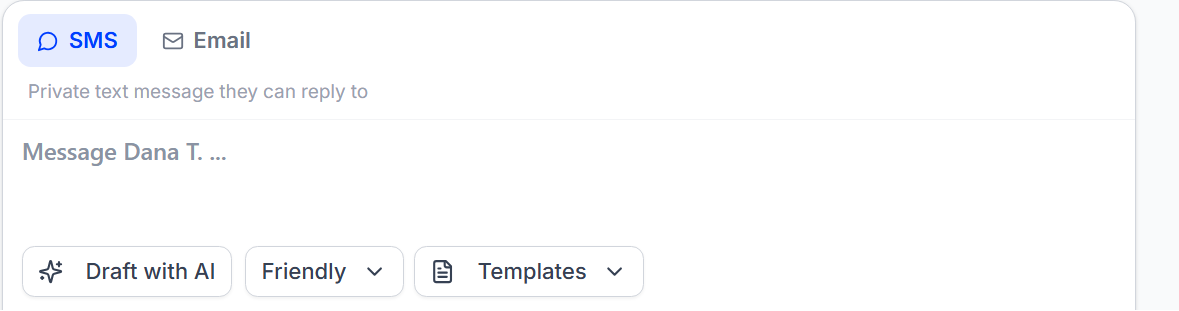
One tactic worth knowing: you do not have to reply publicly first. From the Inbox you can switch from Reply to SMS or Email, sort the problem out privately, and then post a short public reply once there is something good to say. "Glad we could sort this out for you" reads very differently from "please call us".
So, in order
- Check it against the policy list. If it genuinely breaches one, report it — free, and yours to do.
- Reply either way. Take it private if it can be fixed, then reply publicly for everyone who reads it later.
- Get on with collecting reviews. This is the one that compounds, and the only one that makes the next bad review a non-event.
The legal route sits outside that list on purpose: it applies to a small minority of reviews, and reaching for it first usually costs more attention than the review was getting.
Never buy reviews, and never filter who gets asked. The downside is a public notice on your listing and a pause on the reviews you had legitimately earned.